Year 10 Science Foundation is a practical, accessible version of Year 10 Science based on the Australian Curriculum v9. Students explore important ideas such as heredity and evolution, climate and the universe, motion and forces, and patterns in the periodic table and chemical reactions, but in a way that is more applied and grounded in everyday life. The focus is on building confidence with hands-on investigations, asking questions, testing ideas, using evidence, and understanding how science helps explain the world around us.
This course is well suited to students who are not intending to pursue the more academic senior science subjects, but who still want a meaningful and useful science pathway. It can help prepare students for Science in Practice by strengthening practical skills such as carrying out procedures safely, analysing results, communicating findings clearly, and applying science in real-world and workplace contexts. That makes it a strong bridge into an Applied senior pathway that values practical scientific situations, safety, and skills for work and further training.
Unit 1: Our Changing Planet
Students will learn about our changing planet, from the different theories of the origin of the universe to our current changing climate and the evolution of life on the planet. They will develop their inquiry skills of data analysis, evidence evaluation, constructing logical arguments and writing scientifically. They will demonstrate their learning through a persuasive project targeted to their own interests.
| Unit 1 Assessment
Big bang Theory. Theory of Natural Selection. Persuasive task.
|
Unit 2: How Stuff Works
Students will learn about Newton’s law of motion; explain how they apply to real life situations and predict the motion of objects. They will develop their inquiry skills by planning, conducting, data recording, analysis and developing valid conclusions. They will demonstrate their learning through a primary investigation in an area of their interest in the form of a scientific report.
| Unit 2 Assessment Collection of work-mass of car. Explains Newtons’ Laws.
|
Unit3:Chemistry in the World
Throughout this unit, students engage with the periodic table and consider why it is arranged the way it is. They explore how its organisation helps with modern chemistry and learn about the bonding that occurs between atoms. They observe reactions taking place and learn how they occurs at the particle level. Students explore rates of reaction and factors that can influence this.
| Unit 3 Assessment Plan and conduct- Reaction Rates.
|
Unit 4: The Living World
Students will be able to explain the processes that underpin heredity and genetic diversity. Analyse the importance of publication and peer review, and the key factors that influence interactions between science of genetics and inheritance. They will develop their inquiry skills of ethical and intercultural considerations, constructing effective representations, data analysis, evaluate the validity of conclusions and claims.
| Unit 4 Assessment Genetic traits database. Inheritance exam. Genetic disorder response.
|
CADI Clusters for Science
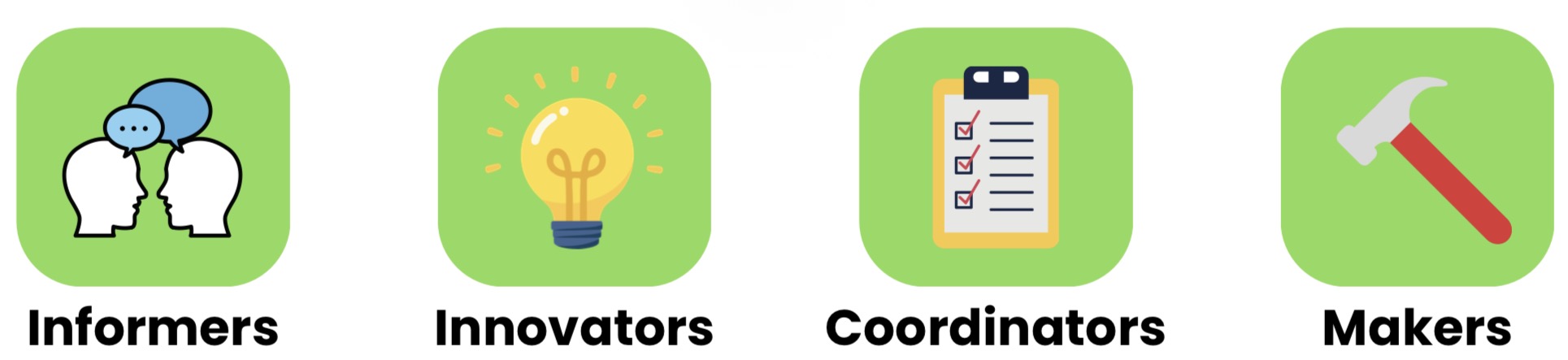
Informers – Analyse data and draw conclusions from evidence. Innovators – Design and test ideas to solve problems. Coordinators – Plan investigations and follow clear scientific steps. Makers – Apply scientific knowledge in practical experiments and models.
|